AI Assistants Now Rival Search Traffic and Law Firms Should Pay Attention
Posted on Wednesday, March 11th, 2026 at 7:10 pm
When Search Is No Longer the Only Starting Point
Search engines have long served as the main way people find information online. That habit still exists, but new data shows that AI assistants are now handling a large amount of online research.
A recent study found that AI tools generate 45 billion sessions each month worldwide. That activity equals about 56% of the volume handled by search engines globally and about 34% in the United States.
Tools such as ChatGPT, Gemini, Perplexity, Grok, and Claude are now common starting points for research. Many people open these tools and ask questions directly instead of typing queries into a search engine.
For law firms, this means potential clients may encounter legal information across several platforms before visiting a law firm website.
Law firms should pay attention because the discovery and purchase journey in legal marketing has changed permanently.
The Numbers Behind the Headline
The study estimates that AI assistants now generate 45 billion sessions every month worldwide. In the United States, AI usage reaches about 5.4 billion monthly sessions.
ChatGPT accounts for the largest portion of this activity. The report estimates that about 89% of global AI sessions occur on ChatGPT, with over 50% of those interactions looking for information.
Many earlier reports compared visits to Google.com with visits to the ChatGPT website alone. That approach missed a large share of how people actually use AI tools.
The research also examined several AI assistants and multiple search engines instead of comparing only two platforms.

AI Assistants Are Now Part of How People Research Information
AI assistants are still used for many tasks, including writing and editing text, but they are increasingly being used to find information.
Researchers estimate that about half of AI prompts involve users seeking answers or guidance. These requests are the closest match to traditional search behavior.
When the study isolates those requests, AI usage equals about 28% of global search activity and about 17% in the United States.
This shows that a growing portion of online research now occurs inside AI assistants.
Google Still Leads but the Market Is Becoming More Competitive
Search engines still handle the majority of online discovery. Google remains the largest source of search traffic by a wide margin.
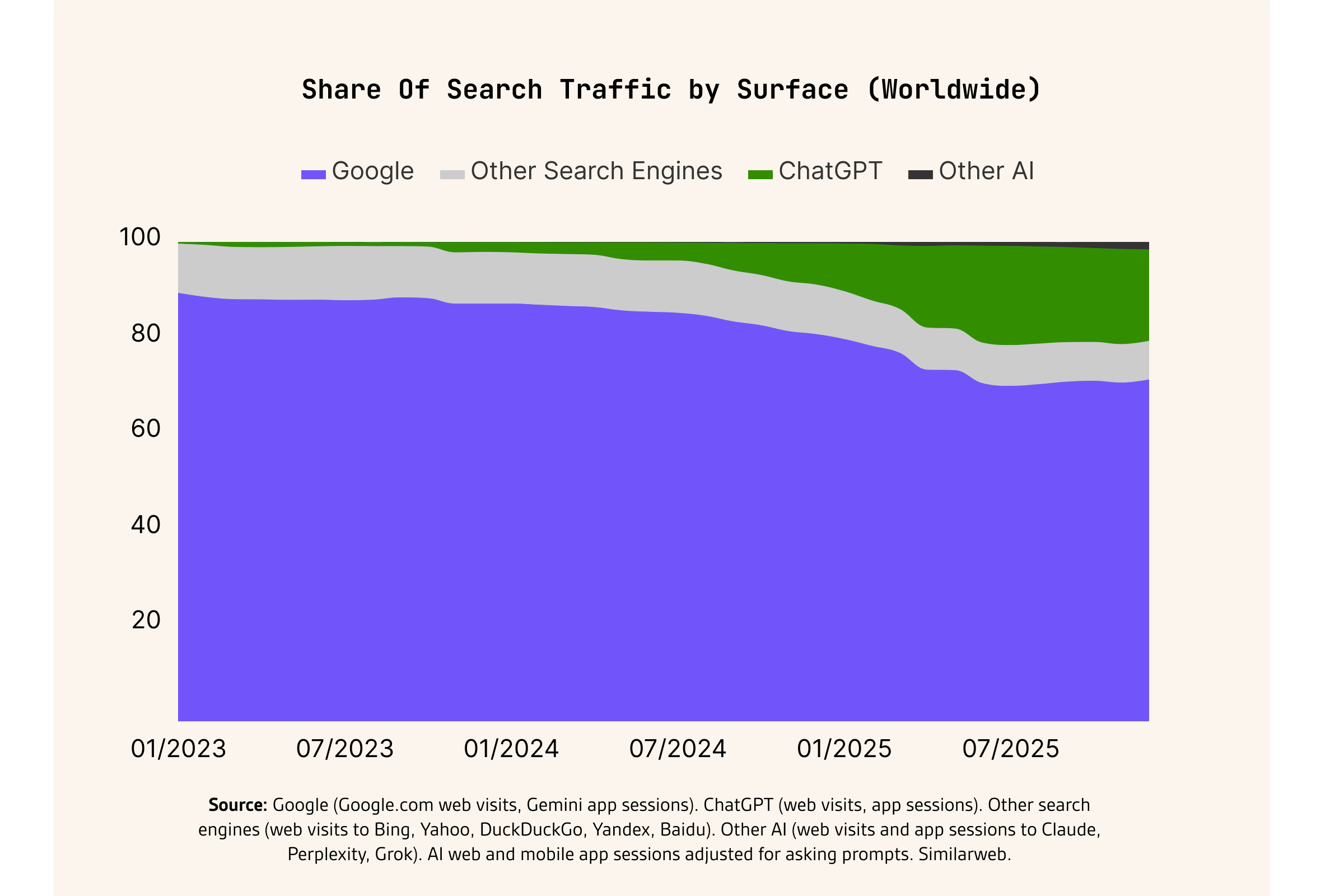
The study estimates that Google held about 89% of search-related activity in 2023. By the end of 2025, that number declined to about 71% worldwide.
ChatGPT alone represents about 20% of search related traffic worldwide and about 12% in the United States when counting information seeking prompts.
A More Measured Look at the Data
The study also provides useful context.
Worldwide AI usage has remained fairly steady since July 2025. Growth has slowed outside the United States, while usage in the U.S. continues to increase quickly. By December 2025, U.S. AI sessions were about 300% higher than the previous year.
The research also shows that search engines continue to attract heavy traffic. Search usage has not declined during the past several years.
Instead, total research activity has grown. When search engines and AI assistants are measured together, global search activity has increased about 26% since 2023.
This means people are researching information online more often than before.
Life After Search Rankings
While search engines remain a major source of traffic, AI assistants are becoming another prominent place for people to find information. This is the first time we’re experiencing a decrease in usage of traditional search engines, and it may continue to decrease as AI gets better.
By now, law firms should know that they are more likely to appear in both traditional and AI search by publishing a higher quality of legal content. Articles and attorney insights help establish authority that search engines and AI systems recognize. When paired with the right technical optimizations on a website, law firms can stay prepared for the next wave of search tech AI brings to the table.
Before rankings become a thing of the past, we encourage all attorneys to think ahead and ask if their firm is “future-proof” in their digital case acquisition. If you want your firm to show up with authority in search engines, AI, and beyond, reach out to TSEG today.


