How Entity Mapping Determines Whether Law Firms Appear in Google and AI Search Results
Posted on Thursday, August 6th, 2026 at 7:21 pm
Why Entity Relationships Matter for Modern Legal Search
Legal search has moved beyond matching pages to individual keywords. Google and AI platforms now evaluate how attorneys, practice areas, office locations, legal topics, and published content relate to one another. When those relationships are clear, search systems can better understand what a law firm does and when it should be presented to someone seeking legal representation.
Competition makes this even more important. Firms with similar experience and comparable websites may receive very different levels of online exposure because one presents a more complete and connected digital profile.
How Google Connects Legal Topics and Attorney Profiles
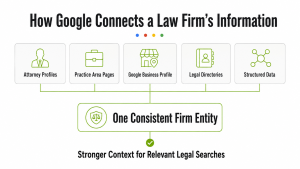
Google evaluates far more than the content on a single page. It compares information across attorney biographies, practice area pages, business profiles, legal directories, and other trusted sources to determine whether they consistently describe the same firm.
Practice pages that reference related services, attorney profiles that support those services, and structured data that accurately identifies people and organizations all help Google develop a stronger understanding of a firm’s experience. Accurate business information across directories further reinforces those connections and reduces uncertainty about the firm’s identity.
Law firms that organize their websites with these relationships in mind give Google more context for matching their content with relevant searches.
How AI Platforms Form Connections Between Legal Entities
AI platforms evaluate legal information differently than traditional search engines. Instead of relying on a publicly recognized framework like Google’s Knowledge Graph, they analyze patterns found across websites, directories, news coverage, legal publications, and other trusted sources.
That means a firm’s reputation extends beyond its own website. When attorneys are consistently associated with particular practice areas, court matters, jurisdictions, or legal topics across multiple sources, AI systems are more likely to recognize those relationships when generating responses.
Firms with limited recognition outside their own websites may be referenced less often, even when their internal content is well written.
Creating a Stronger Foundation Across Google and AI
A successful digital strategy supports both traditional search and AI-generated answers. While each system evaluates information differently, both reward accurate information that appears consistently across credible sources.
Publishing detailed content focused on specific legal matters, geographic markets, and attorney experience helps establish stronger associations. Clear authorship, complete attorney biographies, and accurate business information also make it easier for search systems to understand who the firm represents and what services it provides.
Third-party recognition also strengthens these relationships. Legal directories, reputable media coverage, professional organizations, and citations from respected industry sources all contribute additional context that supports a firm’s online presence.
What Trial Attorneys Should Know About Competitive Markets
Competition among trial lawyers often comes down to how well search systems understand each firm’s experience. Firms that clearly connect attorneys with practice areas, jurisdictions, and relevant legal topics are better positioned to appear when prospective clients research lawsuits, injury claims, or litigation strategies.
Conflicting information can create unnecessary confusion. Outdated attorney biographies, inconsistent directory listings, or inaccurate business details may cause AI platforms to generate incomplete or incorrect descriptions that influence a prospective client’s first impression before any conversation takes place.
Helping Your Firm Build Stronger Digital Authority
Entity mapping continues to influence how legal search platforms interpret and recommend law firms. Building a connected digital presence requires more than publishing quality content. Every attorney profile, practice area, business listing, and external reference should reinforce the same accurate information so search systems can confidently understand your firm.
At TSEG, we help law firms strengthen those connections across Google and AI platforms. We build strategies that improve how search systems interpret your attorneys, practice areas, and online reputation so your firm can reach more prospective clients when they are actively looking for legal representation.


