What Can Law Firms Learn From Google Search Console’s New Generative AI Performance Report?
Posted on Wednesday, August 12th, 2026 at 5:50 pm
Google is giving website owners a clearer look at how their content appears within its generative AI search features.
The Google Search Console generative AI performance report was previously available to a limited number of properties but has now expanded to many more websites. Law firms with access can see which pages Google displays in generative AI features and how often those appearances occur.
The report still leaves out important information, including click and search query data. Even with those limitations, the page-level impression data can help firms identify which legal topics and resources Google frequently includes in AI-generated search experiences.
More Law Firms Are Getting Access
Google has expanded access to its generative AI performance report across substantially more Search Console properties.
The report appears under the Performance section of Google Search Console as “Generative AI features.” It provides a separate view of website performance when URLs appear within generative AI features across Google Search and Discover.
Access has not reached every website. Google’s John Mueller confirmed that the report is not yet available for every domain. Google also states that the report will not appear when a website has not received enough impressions within its generative AI features to provide sufficient data.
Law firms with access now have another source of information for understanding how Google uses their legal content within AI search experiences.
Search Console has long provided data about traditional organic search performance. This report separates some activity connected specifically to Google’s generative AI features, allowing firms to examine which individual URLs appear most often.
That information matters because prospective clients use Google to ask detailed questions about accidents, insurance claims, settlements, lawsuits, disability benefits, and the legal process. A page that regularly appears within generative AI results may indicate that Google considers the content relevant to questions people ask about those subjects.
A Closer Look at the Data
Google currently provides five primary categories of data within the generative AI performance report.
- ⚙️ Impressions show how often URLs from a website appeared in generative AI features across Search and Discover.
- ⚙️ Pages identify which URLs received impressions within those features.
- ⚙️ Countries show where generative AI impressions originated.
- ⚙️ Devices identify the devices people were using when the website appeared in applicable Search results.
- ⚙️ Dates show how impressions changed over time, with hourly, daily, weekly, and monthly reporting available.
The Pages section may be particularly useful for law firms because it allows them to compare articles, practice area pages, and other resources based on generative AI impressions.
Country and device information can provide additional context, while date reporting allows firms to monitor changes in impressions over time.
These measurements should not be treated as proof that a page is producing signed cases. An impression means a URL appeared within a generative AI feature. It does not establish that someone visited the website, contacted the firm, or became a client.
Instead, firms can use the data to determine where their content is already appearing and decide which pages warrant deeper analysis.
The Missing Pieces Still Matter
Clicks and search queries are two major omissions from Google’s generative AI performance report.
A law firm may see that a page received thousands of impressions within Google’s generative AI features, but Search Console does not currently reveal which searches produced those impressions or how many people clicked through to the firm’s website.
That limitation prevents firms from drawing firm conclusions from impression totals alone. Page-level data can still uncover useful patterns when several high-performing URLs address similar types of legal questions.
We are already seeing examples across TSEG client websites.
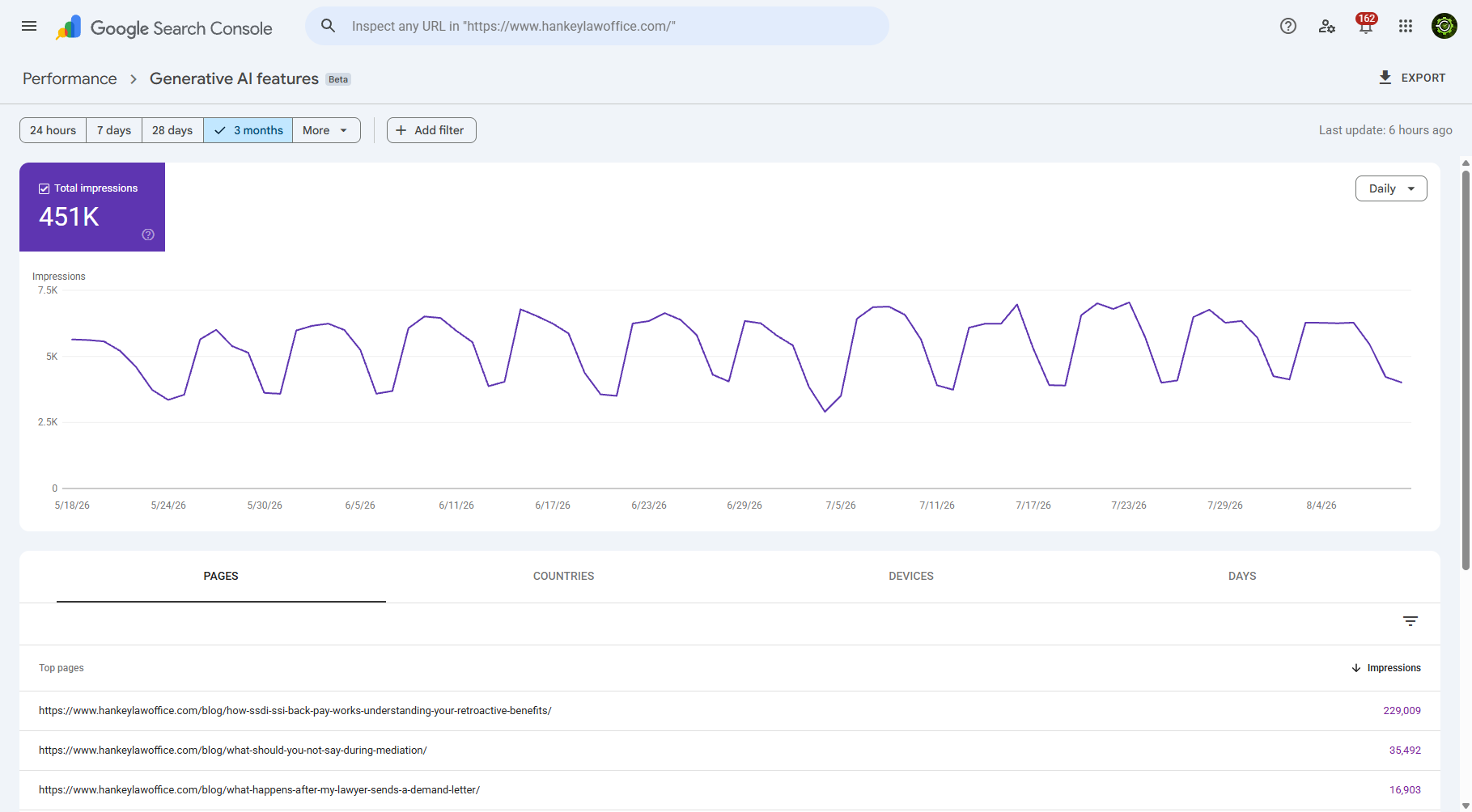
Hankey Marks & Crider Injury & Disability Attorneys recorded approximately 451,000 generative AI impressions during the three-month period shown in Search Console. One page accounted for roughly 229,000 impressions and answers a specific question about how Social Security Disability Insurance back pay works. Other leading pages address what someone should avoid saying during mediation and what happens after an attorney sends a demand letter.
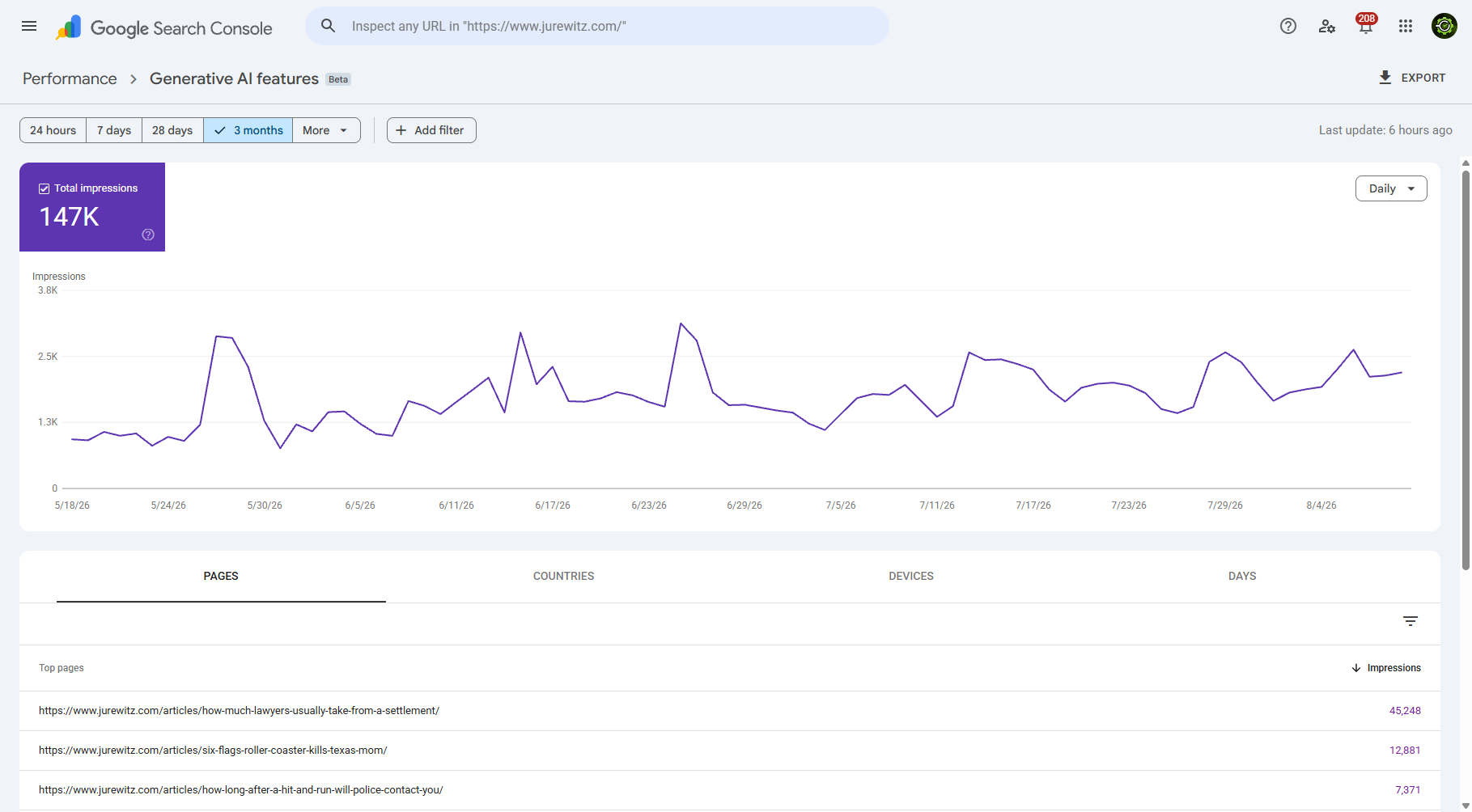
Jurewitz Law Group recorded approximately 147,000 generative AI impressions during the period shown. Its leading page received more than 45,000 impressions and addresses how much lawyers usually receive from a settlement. Another frequently displayed page answers a question about how long after a hit-and-run police may contact someone.
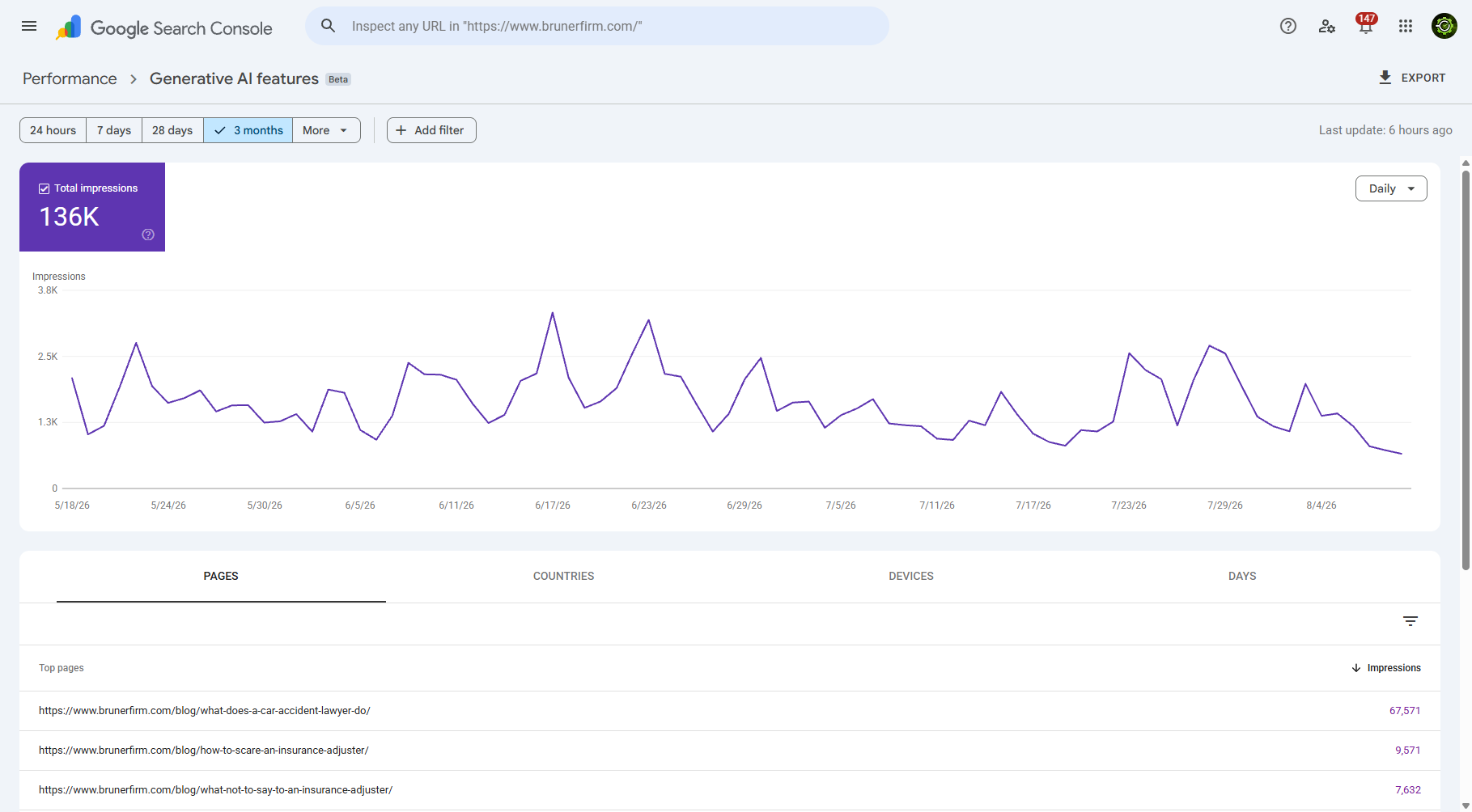
The Bruner Law Firm recorded approximately 136,000 generative AI impressions. Its leading page generated more than 67,000 impressions and explains what a car accident lawyer does. Two other top pages address interactions with insurance adjusters, including how to handle an adjuster and what someone should avoid saying.
These examples share an important characteristic. Several pages receiving substantial generative AI impressions directly answer questions people may have while dealing with a legal problem.
Someone involved in an accident may want to know what happens when an insurance adjuster calls. A person considering a settlement may wonder how attorney fees work. Someone pursuing disability benefits may have questions about retroactive payments.
Content that addresses a defined question gives Google focused information that may be useful when responding to people researching the same subject. The impression data allows firms to see which existing pages Google is already displaying frequently enough to warrant closer examination.
The numbers do not establish why Google selected a particular URL. They can, however, help firms identify common characteristics among pages receiving substantial exposure within generative AI results.
Finding Patterns Worth Exploring
Law firms can begin by reviewing the pages receiving the most generative AI impressions and comparing the subjects, formats, and search intent behind them.
Consider what question each page answers, which practice area it supports, and where the topic may fit within a prospective client’s decision-making process. A page about dealing with an insurance adjuster, for example, reaches someone at a different stage than a page explaining how attorney fees are calculated after a settlement.
Firms can also compare performance across practice areas. If car accident resources repeatedly earn generative AI impressions while pages covering another important case type rarely appear, the difference may justify a closer review of the firm’s content coverage in that area.
Date and geographic data can add another layer to the analysis. Changes over time can show whether generative AI impressions are growing or declining, while country data can help firms understand where those appearances originate.
Search Console does not identify the queries responsible for these impressions, disclose which competing firms appeared for the same questions, or tell a firm which related topics should be published next. Impression data therefore works best when evaluated alongside other SEO information.
At TSEG, we analyze generative AI impression data together with traditional Google Search Console metrics, content performance, competitive research, technical SEO findings, and each firm’s client acquisition goals. Combining those sources helps us determine which pages deserve further investment and where new content may support a firm’s broader search marketing strategy.
The appropriate action will vary by firm. One website may benefit from expanding a group of articles that answer common questions after an accident. Another may have useful content that needs stronger internal connections to relevant practice area pages. Other firms may uncover gaps in case-type coverage, technical SEO problems, or legal questions that competitors have not addressed thoroughly.
Turning the Data Into a Plan
Google’s generative AI performance report gives law firms another source of information about how their content appears within AI-driven search experiences. The impression totals become more useful when firms compare them with the rest of their search marketing data.
Pages receiving substantial impressions can point to legal subjects worth studying more closely. Firms can then decide whether the findings support updates to existing content, new articles, stronger practice area resources, technical improvements, or better connections between informational content and pages designed to generate cases.
At TSEG, we help law firms make those decisions using Search Console data, competitive research, content analysis, technical SEO findings, and client acquisition goals. We can help determine what the generative AI data means in the context of a firm’s broader SEO program and develop a practical plan based on what the numbers show.
If your law firm needs help interpreting its Google Search Console generative AI data or deciding where to focus its SEO efforts next, contact TSEG.


