Google “Crawled Not Indexed” Warning Raises New Questions About AI Content Quality
Posted on Friday, July 17th, 2026 at 10:31 pm

When Indexed Pages Become Less Predictable
Google has been serving websites with a “crawled but currently not indexed” status that basically means your webpages are processed by Google but not included in search results. The issue has gained attention as more sites use AI to increase content output. Even pages with a defined purpose and sound organization may be omitted from the index without a stated reason. Marketers and attorneys are left examining content quality, site architecture, duplication, and other factors that may affect index inclusion.
Law firms are now dealing with a less predictable path from content publication to ranking. Adding more pages no longer leads to consistent results, even when those pages follow established optimization practices. The disconnection between crawling and indexing now determines whether content contributes to client acquisition. In short, law firms need to look more closely at what gets published and why.
Why Google Continues to Favor Distinct Content
Representatives of the search giant continue to emphasize that indexing is selective and based on perceived value. Pages that feel repetitive or too similar to existing material are more likely to be skipped. This holds even when AI tools are used carefully, and the writing appears too polished.
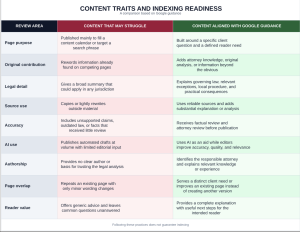
Google advises publishers to assess whether a page provides original information and substantial added value compared with other search results. Content that restates existing material without further analysis may offer readers little reason to choose it over original content. Legal marketers can strengthen an article with firsthand attorney commentary, insight drawn from personal case experience, and accurate authorship information. These additions help distinguish the page from broader, recycled legal summaries.
What This Means for Legal Content Planning
Legal topics are highly competitive, which makes duplication harder to avoid. There’s only so many ways to write about personal injury topics… Practice area pages and blog posts often cover similar ground across many firms and many markets. When AI is used to generate these assets without adding new insight, the likelihood of exclusion increases.
Firms should reconsider how much content they’re publishing. The American Bar Association recommends a quality-over-quantity approach to digital marketing. A smaller set of fully developed pages gives attorneys more room to add case experience, jurisdiction-specific analysis, and their own perspective. These additions can make each page more useful and distinct. Firms can then monitor indexing and search performance to determine which pages produce lasting results.
Site Structure Still Influences Indexing Outcomes
Content alone does not determine whether a page is indexed. Internal linking, crawl paths, and page hierarchy all play a role in how Google prioritizes content. Pages that are difficult to reach or poorly connected within the site may be overlooked.
Strong site organization helps search engines understand which pages matter most. Practice area hubs and clear navigation reinforce the importance of core topics. Thoughtful linking between related pages also strengthens context. When structure and content work together, indexing rates improve, and more pages gain traction.
Why Content Standards Are Getting Higher
Google is applying stricter criteria to what gets indexed as more AI-generated material enters the web. Yes, even Google is fighting the AI slop. Pages are evaluated not just on writing clarity, but on whether they add something meaningfully different. This raises expectations for firms whose SEO providers rely on templated or repetitive content.
Treating content as a commodity will lead to weaker outcomes over time. Lawyers who invest in depth, credibility, and originality are more likely to see consistent indexing moving forward. The focus has moved toward earning inclusion rather than assuming it.
How TSEG Helps Law Firms Get More Pages Indexed
At TSEG, we work directly with trial attorneys to improve how content performs from creation through indexing. Our approach combines authoritative legal writing with site architecture that supports stronger indexing outcomes. We identify gaps where pages fail to differentiate and rebuild them with clear value and attorney insight.
We also refine internal linking and page hierarchy, so search engines can better understand the importance of each asset. This results in more pages being included and positioned to generate qualified leads. Law firms that partner with us gain a clearer path from content investment to measurable growth. Reach out to us today if your website is in need of a new content strategy.


