How ChatGPT Ads Are Reshaping Legal Client Discovery
Posted on Thursday, April 2nd, 2026 at 4:04 pm
Ads Enter the Chat Interface
A new form of advertising is taking shape inside OpenAI’s ChatGPT. Free-tier users in the United States are now seeing sponsored links embedded directly within responses, with expansion already underway in other countries.
These placements appear within the conversation itself. A clickable link sits beneath the response and aligns closely with the user’s question. That positioning puts advertisers directly in front of users at the moment they are considering next steps, rather than off to the side as seen in traditional digital ads.
Law firms now have a new point of visibility. AI platforms are beginning to influence how people search for answers and evaluate options. As Sam Altman moves forward with this rollout, firms need to monitor how these placements are shaping client discovery.
How Often These Ads Actually Appear
In a sample of 500 prompts, sponsored links appeared in roughly 20% of new conversation threads. The placement is consistent. Ads appear at the bottom of a response as a single link tied to the user’s question. There are no pop-ups or interruptions. The format blends into the experience, which increases the likelihood that users will treat the link as a natural extension of the answer.
The position of these ads matters more than how often they appear. When a firm is introduced in tandem with a trusted response, it benefits from the credibility of the platform itself. This proximity influences how prospective clients decide whether to contact a firm, especially when they are searching for guidance on complex issues.
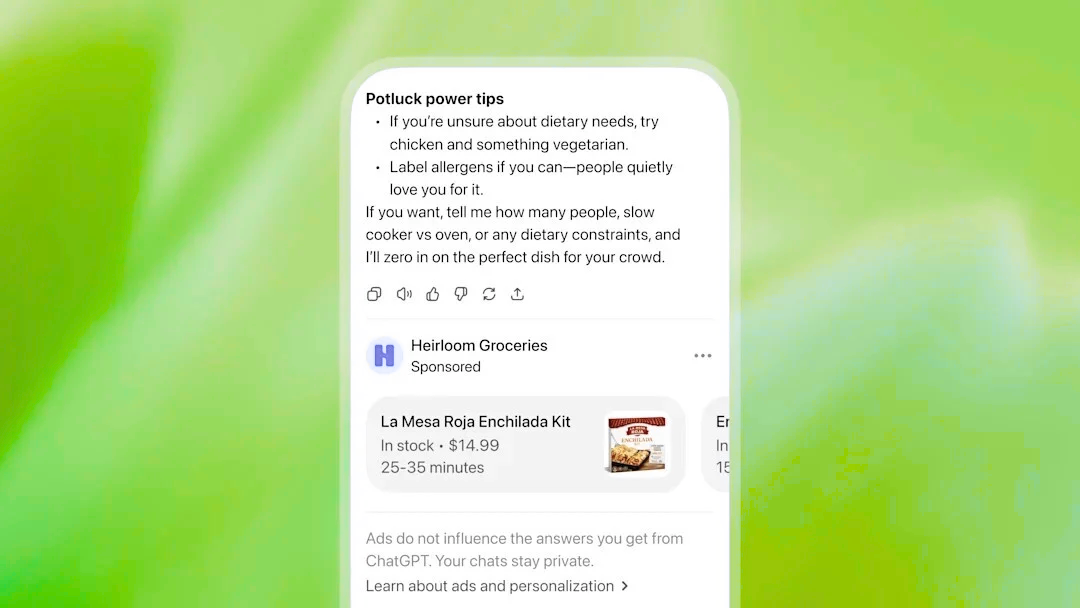
ChatGPT Ad Example
Why Certain Searches Are More Likely to Show Ads
The range of ads already appearing inside ChatGPT covers a wide mix of industries. Users have reported seeing promotions for travel bookings, software tools, streaming services, financial products, and event tickets. Among these, travel-related prompts appear to trigger ads more frequently than other categories.
When a user asks about planning a trip or booking a service, the platform can reasonably assume a readiness to act. Ads tied to those queries are not random.
This raises an important question for law firms. If someone asks about legal rights, case timelines, or next steps after an incident, those queries carry similar intent. As targeting becomes more refined, firms must consider how their services could appear in response to those high-value searches.
How Competing Firms Show Up in the Same Conversation
One of the more notable behaviors in early testing involves what marketers have long called conquesting. When a user mentions a brand by name, the ad that appears is not always for that company. In some cases, it promotes a direct competitor instead.
This approach is familiar in traditional paid search, where brands bid on competitor keywords to capture attention at the moment of consideration. Seeing it appear inside ChatGPT shows that the same strategy is already being applied within AI-driven interactions.
This creates immediate concerns around brand protection for law firms. If a prospective client searches for a specific firm or well-known practice area, competing firms also have an opportunity to appear in that same conversation. Monitoring how and where your firm shows up, along with who appears alongside you, will soon become part of a broader digital strategy.
Where Law Firms Stand as ChatGPT Ads Expand
The introduction of ads inside ChatGPT starts a new path for client discovery. Prospective clients are no longer limited to traditional search engines when looking for answers. They are beginning to ask AI platforms direct questions about legal issues, timelines, and next steps, often with strong intent behind those queries.
Firms that prioritize their authority capture attention before they reach out to a provider. At the same time, firms that ignore this channel risk losing that position to competitors who are quicker to test and invest in emerging ad placements. Brand reputation, paid media strategy, and content alignment all play a role in how firms appear within AI-driven results.
At TSEG, we are already tracking how sponsored placements inside ChatGPT develop and how they influence client behavior. Our team works with law firms to ensure they remain visible as new channels begin to shape how people search for legal answers. As this space grows, we help firms adjust their strategy to stay competitive as new ad placements gain traction.


