New AI Market Share Data Shows Where Law Firms Need to Be Found
Posted on Friday, September 25th, 2026 at 10:23 pm
AI Search Market Share Is Changing Fast and Law Firms Need to Know Where Clients Are Looking
AI search is becoming a larger part of how people find information online, but the audience is no longer concentrated on a single platform.
New Comscore data shows that ChatGPT still accounts for the largest share of AI assistant prompts in the U.S. Yet competitors gained considerable ground during the first half of 2026. At the same time, Google’s AI Overviews are appearing in a growing portion of traditional searches.
For law firms, the numbers make a strong case for looking beyond one AI platform when evaluating search performance.
 ChatGPT Still Leads but Its Share Is Falling
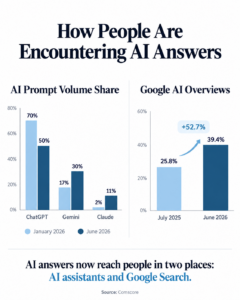
Comscore reported that ChatGPT accounted for 70% of AI prompt volume in January 2026. By June, its share had fallen to 50%.
That does not mean people stopped using ChatGPT. The AI assistant category is growing while users spread their activity across more platforms.
Gemini was one of the biggest beneficiaries. Its share of AI prompt volume increased from 17% in January to 30% in June.
Claude also gained ground during the same period. Its share increased from 2% to 11%.
These figures show why law firms should avoid treating ChatGPT as a stand in for all AI search activity. Someone researching a legal question may now encounter answers through ChatGPT, Gemini, Claude, Google Search, or another AI powered experience.
Google AI Overviews Put AI in Front of Traditional Search Users
AI chat platforms are only part of the story.
Comscore found that AI Overviews appeared in 39.4% of U.S. desktop Google searches in June 2026. That was up from 25.8% in July 2025.
This matters for law firms because people do not have to intentionally open an AI assistant to encounter an AI generated answer. Google can put one directly in front of someone conducting a traditional search.
A prospective client researching a car accident claim, divorce, criminal charge, business dispute, or another legal matter may encounter an AI Overview before reaching conventional organic results.
Law firms therefore have two related audiences to consider. Some people are intentionally asking questions inside AI assistants. Others are encountering AI responses while using Google as they normally would.
AI Search Is Becoming a Multi Platform Channel
The market share numbers also challenge the idea that firms can optimize for one AI platform and consider the job finished.
ChatGPT’s share of prompt activity remains substantial, but Gemini’s growth gives Google another major point of contact beyond AI Overviews. Claude’s growth adds another audience that legal marketers should watch.
Different AI systems can also rely on different sources when constructing responses. A law firm appearing frequently in one platform is not guaranteed the same presence in another.
This makes platform specific monitoring more useful.
Legal marketers can test the questions prospective clients commonly ask and document whether the firm appears in answers across ChatGPT, Gemini, Google AI Overviews, AI Mode, Claude, Perplexity, and other relevant services.
Those tests can include practice specific questions, location based searches, attorney recommendations, and informational queries that frequently occur before someone contacts a firm.
Google Still Deserves Significant Attention
Growth among standalone AI assistants should not distract firms from Google’s enormous existing search audience.
AI Overviews are being incorporated directly into a search product consumers already use. Their increasing presence means Google can expose a law firm to AI search behavior without requiring users to adopt an entirely new platform.
That makes Google’s AI experiences particularly important when reviewing a legal SEO program.
Traditional organic search performance still matters, but firms should also examine whether their content is suitable for the types of detailed questions that AI generated results attempt to answer.
Practice area pages, attorney authored resources, FAQs, case related educational content, and other useful legal resources can all contribute to a firm’s broader search presence.
Market Share Should Guide Attention Rather Than Dictate Strategy
The current numbers can help legal marketers decide where to spend their time, but market share alone should not determine where a firm invests.
A smaller AI platform could still matter if its audience includes people researching high value legal services. Likewise, a platform with a massive audience has limited marketing value if appearances never contribute to qualified inquiries.
Law firms should compare platform presence with actual website and intake data whenever that information is available.
That means looking at referral traffic, landing pages, phone calls, form submissions, consultation requests, qualified leads, and signed cases alongside AI search appearances.
The question is not simply whether a law firm appears in AI. The more useful question is whether those appearances are reaching potential clients and contributing to business.
What Law Firms Should Track Now
Legal marketing reports should begin separating AI search into distinct platforms rather than placing every AI interaction into one category.
Firms can monitor how often they appear for valuable legal questions across Google AI Overviews, Google AI Mode, ChatGPT, Gemini, Claude, and Perplexity. They can also track which platforms send website traffic and what visitors do after arriving.
Traditional SEO data remains useful in this process. Organic rankings, clicks, impressions, landing page traffic, and conversions provide context for understanding whether changes in AI search are affecting established acquisition channels.
Lead and intake data complete the picture. If an AI platform begins sending qualified prospects, firms should be able to identify that activity and determine which content contributed to it.
This approach gives legal marketers a way to respond to changes in platform usage without rebuilding their strategy every time a new market share report is released.
TSEG Helps Law Firms Measure Search Where It Matters
The latest market share numbers show that AI search behavior is being distributed across a growing collection of platforms. ChatGPT remains a major source of AI activity, Gemini is gaining ground, Claude has expanded its share, and Google is placing AI generated answers directly inside traditional search.
Law firms need reporting that accounts for those different ways potential clients can discover legal information.
At TSEG, we help law firms evaluate their presence across traditional and AI search while connecting marketing performance with qualified leads and signed cases. We can identify where a firm appears across major AI platforms, find content opportunities, monitor changes in search behavior, and connect that activity with the client acquisition metrics that matter to the practice.
As AI search usage continues to develop, we help firms determine which platforms deserve attention based on data rather than assumptions.


