What Law Firms Should Know Before Google’s Next Algorithm Update
Posted on Thursday, October 8th, 2026 at 12:32 am
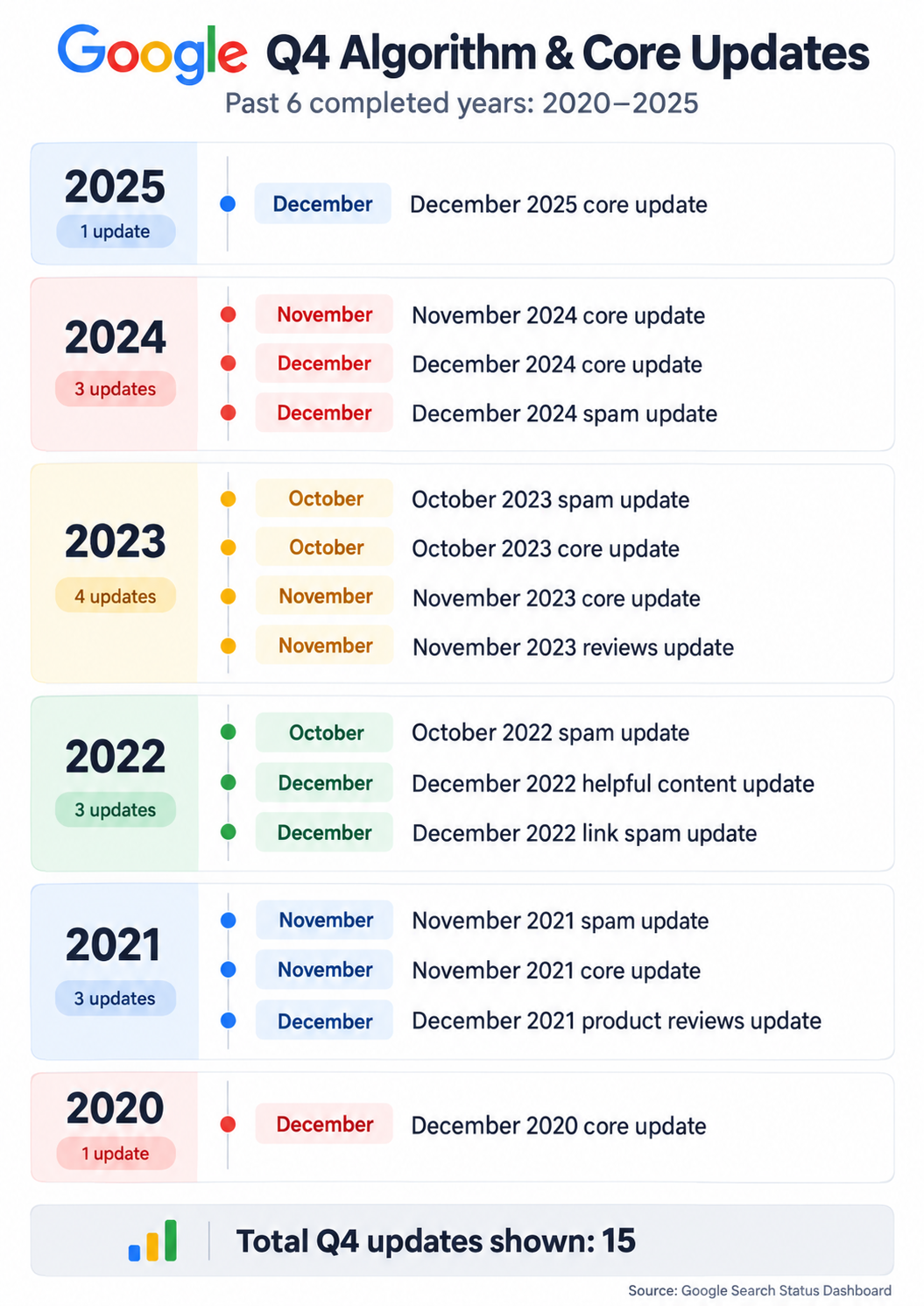
Google hasn’t announced its next major algorithm update, but past release patterns suggest another could arrive before the end of 2026. The search engine has introduced significant ranking changes during the fourth quarter (Q4) in recent years, including core updates in November and December 2024 and December 2025. While another year-end update is far from guaranteed, the timing gives law firms good reason to prepare for potential changes to organic search rankings.
Based on Google’s previous updates and recent revisions to its content quality guidance, there are several areas that could receive greater attention in the coming months. Original legal content, accurate authorship information, AI-generated material, and overall website usability are among the considerations worth examining. Google has not confirmed that these areas will be targeted in its next update, but its published guidelines offer clues about where the company continues to place emphasis.
For personal injury attorneys and other firms competing in highly competitive search markets, anticipating potential changes can help prevent reactive decisions after rankings fluctuate. Websites containing repetitive practice area pages, outdated legal information, or content produced without meaningful attorney oversight may deserve closer examination before another update arrives.
With that in mind, this article takes a proactive, informed look at what Google’s next algorithm update could mean for law firms. Drawing on previous ranking changes and the company’s existing guidance, we’ll examine what attorneys might expect, which SEO practices deserve attention, and how firms can prepare before Google makes its next announcement.
Google’s Content Quality Standards Could Influence Future Rankings
Google’s content guidance identifies four characteristics used by its search quality evaluators when reviewing a webpage’s main content. These include effort, originality, talent or skill, and accuracy.
These characteristics are particularly relevant to legal websites because prospective clients frequently search for information involving financial recovery, legal obligations, and important filing deadlines.
Consider two personal injury firms publishing articles about Texas car accident claims.
One provides a general explanation of insurance claims, medical expenses, and settlement negotiations. The information may be accurate, but readers could find similar material across numerous competing websites.
The other examines how Texas proportionate responsibility laws affect potential compensation, explains disputes involving insurance coverage, and discusses factors that may complicate liability determinations.
Both articles address the same subject, but the second provides information that could help someone better understand the circumstances affecting their claim.
This distinction aligns with Google’s emphasis on content demonstrating original effort and appropriate subject matter expertise.
Why Legal Content Receives Additional Scrutiny
Google’s search quality guidelines identify certain subjects as Your Money or Your Life (YMYL) topics. These include information that could significantly affect a person’s health, financial stability, safety, or general well-being.
Articles discussing personal injury settlements, medical malpractice claims, wrongful death lawsuits, and legal filing deadlines can fall within this category.
Incorrect legal information can have meaningful consequences. A visitor who misunderstands a statute of limitations or receives an incomplete explanation of liability rules may make decisions based on inaccurate assumptions.
Google’s guidance therefore places particular emphasis on accuracy and trustworthiness when evaluating content involving consequential decisions.
Attorneys can contribute professional knowledge that general legal publishers may struggle to reproduce. Explaining jurisdictional exceptions, litigation procedures, and common complications gives readers information grounded in the realities of legal practice.
Google’s experience, expertise, authoritativeness, and trustworthiness framework, commonly called E-E-A-T, also provides a useful reference when assessing content. E-E-A-T is not an individual ranking factor, but Google’s automated systems use multiple considerations associated with these qualities.
Written Articles May No Longer Be Enough to Meet Every Searcher’s Needs
Another noteworthy aspect of Google’s content guidance is its treatment of the different elements that can contribute to a webpage’s main content.
Articles and practice area descriptions remain important, but Google also recognizes videos, images, interactive tools, and expandable information when they help accomplish the page’s purpose.
This creates opportunities for law firms to present complicated legal information in formats suited to different client questions.
Attorney Videos Can Explain Complex Legal Procedures
Prospective clients may find certain legal subjects easier to understand when an attorney explains them directly.
A short video discussing what happens during a personal injury deposition, for example, could describe the questioning process, preparation requirements, and common concerns clients have before providing testimony.
These videos also give prospective clients an opportunity to become familiar with the attorneys who may represent them.
Other appropriate subjects include initial consultations, settlement negotiations, mediation, and the general stages of litigation.
Videos should supplement accessible written information, particularly when visitors need to locate specific details quickly. Captions and transcripts can help make the material available to a broader audience.
Interactive Website Features Can Provide Practical Assistance
Interactive resources may also help prospective clients understand legal processes and prepare for conversations with an attorney.
A law firm’s website could include resources such as the following.
- ⚙️ A timeline illustrating the general stages of a personal injury lawsuit
- ⚙️ A consultation checklist outlining potentially relevant documents
- ⚙️ State-specific resources explaining general filing deadlines and exceptions
- ⚙️ Searchable FAQs addressing common questions about particular claims
Accuracy remains important when developing these features.
A resource discussing statutes of limitations should acknowledge that exceptions may apply and avoid presenting generalized deadlines as definitive legal advice.
Google has not stated that adding interactive elements guarantees higher rankings. Their value depends on whether they genuinely improve the experience of people using the website.
AI-Generated Legal Content May Face Greater Quality Concerns
Generative AI has made producing legal marketing content faster and more accessible. However, Google’s guidance raises concerns about publishing large quantities of material without meaningful oversight.
Google does not prohibit AI-assisted writing. Its policies focus on the quality and purpose of the resulting content, including whether pages are created primarily to manipulate search rankings.
For law firms, the most immediate concern involves factual accuracy.
AI-generated material can contain outdated laws, incorrect statutory references, invented legal authorities, or explanations that overlook differences between jurisdictions.
An article discussing medical malpractice deadlines, for instance, may describe a general filing period without addressing exceptions that could materially affect a particular claim.
Publishing that information without attorney review could mislead readers and create reputational concerns for the firm.
Accurate Authorship and Attorney Credentials Deserve Attention
Google’s guidance also warns against misleading information about who created website content.
Fabricated author profiles, false professional credentials, and AI-generated headshots presented as real experts can make a website appear more authoritative than it actually is.
Law firms should ensure that published biographies accurately represent attorney qualifications, bar admissions, and professional experience.
When an article identifies an attorney as its author or reviewer, that representation should reflect the person’s actual involvement.
A consistent editorial process can help prevent these problems. Qualified attorneys should review substantive legal explanations, particularly those involving jurisdiction-specific requirements or claims that could influence a prospective client’s decisions.
The goal is to ensure that professional credentials and legal information accurately reflect the people and expertise behind the website.
Repetitive SEO Content Could Create Problems for Law Firms
Many legal websites have extensive collections of practice area pages, location pages, and blog articles targeting closely related searches.
These pages can serve legitimate purposes, particularly when a firm represents clients across multiple jurisdictions or handles several distinct types of cases.
However, creating numerous pages with substantially similar information can raise concerns under Google’s existing spam policies.
Location Pages Need a Clear Reason to Exist
Consider a personal injury firm targeting Dallas, Fort Worth, Arlington, and Plano.
Individual city pages may be useful when they explain the firm’s services in each community, identify legitimate office locations, or provide locally relevant information.
Problems arise when dozens of pages repeat nearly identical text with only the city names changed.
Google’s doorway abuse policy addresses certain types of pages created to rank for similar searches while providing little independent value.
Firms should examine whether each location page offers information that distinguishes it from other pages on the website.
A page describing services available to Fort Worth residents, for example, should provide accurate information relevant to that audience rather than reproducing a Dallas page with minor wording changes.
This review may reveal opportunities to improve existing pages, consolidate overlapping material, or remove content that no longer serves a meaningful purpose.
Keyword Usage Should Support Readability
Keywords remain relevant to legal SEO because they help identify a webpage’s subject.
A personal injury firm still needs descriptive page titles, practice area terminology, and headings that reflect the legal questions being discussed.
However, repeatedly inserting variations of the same search phrase can make content awkward and difficult to read.
An article targeting truck accident searches should provide substantive information about liability, evidence preservation, commercial insurance, and other relevant concerns.
Repeating the phrase “truck accident lawyer” throughout unrelated headings adds little for prospective clients.
Google’s guidance favors titles and headings that accurately represent the material on the page. Legal marketing teams should evaluate keyword placement alongside the clarity and usefulness of the finished content.
How Law Firms Can Prepare Their Websites Before the Next Update
Google has not disclosed the changes that will accompany its next major algorithm update. Still, firms can examine known website weaknesses and establish a stronger basis for evaluating future ranking movements.
The following steps can help attorneys and marketing teams prioritize that work.
1. Conduct a Detailed Legal Content Audit
Review existing practice area pages, blog articles, and location-specific content for inaccurate information, outdated references, and incomplete explanations.
Give particular attention to articles involving statutes of limitations, damage caps, comparative fault rules, and other legal requirements that may vary by jurisdiction.
Pages that already attract qualified traffic should be evaluated carefully before substantial changes are made. Revisions should address documented problems rather than assumptions about an upcoming update.
2. Review Attorney Profiles and Content Attribution
Confirm that website biographies accurately reflect professional qualifications, admissions, experience, and current practice areas.
Examine article bylines and review credits to ensure they represent actual attorney involvement.
Firms using AI-assisted content should establish clear procedures for verifying legal information before publication.
3. Evaluate Website Usability and Client Contact Options
A law firm’s website should make it easy for visitors to find information and understand how to request legal assistance.
Review mobile performance, page loading speed, navigation, readability, and the accessibility of contact forms.
Test the consultation process on mobile and desktop devices to identify problems that could prevent inquiries from reaching the firm.
A visitor researching a wrongful death lawsuit should be able to locate relevant legal information and contact an attorney without working through unnecessary navigation.
4. Establish a Baseline for Organic Search Performance
Google Search Console provides information about clicks, impressions, search queries, and average search positions.
Review this data before a new update begins so the firm has a reference point for future comparisons.
Examine performance by practice area, location, and individual page rather than relying exclusively on overall website traffic.
If rankings decline after an update, investigate whether the changes are concentrated in particular sections or appear across the website.
Google recommends waiting until a core update finishes rolling out, followed by at least a full week, before assessing its effects through Search Console.
Ranking changes also need context. Seasonal fluctuations, changes in search demand, and modifications to Google’s search results can influence traffic independently of a core update.
5. Reevaluate the Firm’s Content Publishing Strategy
Before commissioning additional articles, examine whether proposed topics answer questions that existing pages do not adequately address.
Search volume can help identify demand, but it should not determine whether an article deserves publication.
A personal injury firm might develop detailed content about medical liens, evidence preservation after commercial vehicle accidents, or how multiple liable parties affect a claim.
Each topic addresses a separate concern that could arise during a prospective client’s search for legal representation.
Involving attorneys during content planning can help identify questions that generic keyword research may overlook.
Prepare for Google’s Next Algorithm Update With TSEG
Google’s next major algorithm update remains uncertain, but its published guidance gives law firms practical reasons to examine their current SEO strategies. Content accuracy, trustworthy authorship, appropriate keyword usage, and website usability all deserve attention when evaluating a firm’s online performance.
For personal injury attorneys and other firms competing in crowded search markets, preparation begins with understanding which pages attract potential clients, where existing content falls short, and how website improvements can support long-term organic growth.
At TSEG, we help law firms evaluate their search performance and develop SEO strategies built around the demands of legal marketing. Our team examines content quality, organic traffic, practice area performance, and website functionality to identify opportunities for improvement.
We also help attorneys develop legal content that addresses relevant client questions, strengthen existing pages, and establish marketing strategies designed to attract qualified inquiries.
With Google’s search systems continuing to change, we work with law firms to make informed SEO decisions based on their competitive markets and business objectives.
Contact TSEG to discuss how we can help your firm assess its current search performance and prepare its website for Google’s next algorithm update.


