New York’s Synthetic Performer Law Takes Effect – Impact on Legal Advertising
Posted on Friday, June 26th, 2026 at 8:00 am
A New Production Check for Legal Advertising
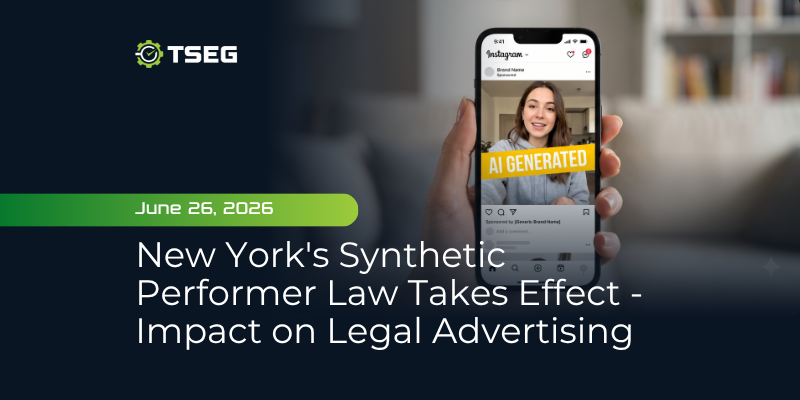
New York Law now requires a business to conspicuously disclose that a commercial advertisement contains a synthetic performer. The law took effect on June 9, 2026 and directly impacts how attorneys advertise online. In short, any ads that use AI to generate characters that look like real humans must contain a visual disclosure that it’s AI generated and not a real person.
Violations could potentially impose a civil penalty of $5,000 per instance, with the first violation fee starting at $1,000.
Law firms advertising in New York should review the visual and audiovisual materials used to promote their legal services. Relevant assets may include social media campaigns, website videos, streaming ads, and even traditional ads like TV, print and OOH.
Creative work often passes through agencies, freelance contractors, software vendors, and media teams before an attorney sees the final version. A reliable approval process should identify the source of each human figure before the campaign launches.
What Counts as a Synthetic Performer
The statute defines a synthetic performer as a digitally created asset that was created, reproduced, or modified by computer through generative AI or a software algorithm. The asset must create the impression of a visual or audiovisual human performance by someone who is not recognizable as an identifiable natural performer.
Legal advertising examples may include a fabricated client discussing an injury, a digital spokesperson describing the firm’s services, an avatar portraying an attorney, or a computer generated accident victim appearing on a landing page.
The definition also includes assets made through a software algorithm. Production teams should ask how the person was created rather than relying on a vendor’s preferred label for the technology.
Coverage centers on the human performance asset. AI used solely to draft copy, create background art, correct color, clean an image, or animate a nonhuman object does not satisfy this definition by itself.
A digital depiction recognizable as a specific natural person falls outside this particular definition. That content may still raise questions involving consent, privacy, publicity rights, copyright, contracts, or misleading advertising. Section 396 b expressly preserves rights available under other laws.
General Exemptions and Rules for Publishers
Audio advertisements are exempt. An audio placement containing a synthetic voice therefore receives different treatment under this statute from a video showing a digital human figure.
The law also exempts content when AI is used solely to translate the language of a human performer. Work that creates a new person, modifies the performer’s appearance, or changes the performance beyond translation requires a separate assessment.
Promotional materials for movies, television programs, streaming content, documentaries, video games, and similar audiovisual works may qualify for another exemption. The synthetic performer’s use in the promotion must be consistent with the performer’s use in the expressive work being promoted.
The statute excludes advertising media publishers that publish or distribute the content. Its examples include newspapers, magazines, television networks, streaming services, cable systems, billboards, and transit advertising.
Law firms should not expect a publisher or advertising platform to inspect every creative file or insert a missing notice. The firm’s production and approval process remains the practical place to identify affected content.
Where Search Marketing Teams Should Look
Paid search campaigns often lead users to pages containing videos, testimonials, case descriptions, or interactive content. The search ad may contain no human figure while the destination page includes a digital spokesperson. Landing pages are regularly considered advertising for law firms.
Display and programmatic campaigns present another area for review. A single approved image can appear in many sizes and placements, and automated creative tools may produce additional versions from the original assets.
Video ad campaigns, on social media or streaming platforms, require attention to both the performer and the disclosure treatment. A notice that works in a video designed for large screen viewing may become unreadable when the same content is edited for smaller smartphone screens.
Campaign audits should include materials launched before June 9 that remain active. The statute does not expressly address an advertisement first published before the effective date and distributed afterward. The firm’s counsel should evaluate continued use of older creative that contains a digital human figure.
A Six Step Review Process for Law Firms
- Map Current Advertising Assets
Create an inventory of visual and audiovisual content available to New York consumers. Include social media ads, landing pages, display ads, website media, sponsored content, streaming placements, and traditional creative. - Document the Source of Each Human Figure
Classify every person shown as a real attorney, employee, client, actor, licensed stock model, composite image, digital avatar, or fully generated person.
The file should also identify any computer modification that materially affected the person’s appearance or performance. - Demand Transparency From Marketing Teams and Vendors
Require agencies, producers, freelancers, and software vendors to disclose any synthetic human asset used in the work. Their response should cover subcontractors, stock libraries, avatar platforms, and other production tools. The request should address how the asset was created, whether it represents a real person, and which files contain it. - Implement a Trustworthy Review Process
Creative approval procedures should ask whether any visual or audiovisual human performance was created, reproduced, or modified through generative AI or a software algorithm. If the creative producer isn’t already reviewing for compliance, a positive or uncertain answer should send the asset to the firm’s counsel before publication. - Place Disclosing Language in the Creative
When disclosure is required, add the notice to the advertisement itself. Review readability, placement, timing, contrast, and treatment across every size or edit. Publication instructions should prevent media vendors from cropping, covering, or removing the notice. - Revise Production Agreements
Agreements with agencies and producers should address reporting of synthetic assets, approval duties, record retention, revision requests, and responsibility for content that was not disclosed during production. The agreement should also require notice before a vendor replaces a real performer with a digital person or uses a new tool that alters a human performance.
Enforcing Compliance In Legal Marketing Campaigns
AI generated ad creative has been a long debated topic in legal marketing. Many lead generation companies now promote fully automated systems as replacements for an ad agency, promising campaigns that can test hundreds of creative variations without paying real actors, user generated content (UGC) creators, or a production team. The pitch is to save on costs by removing human involvement from these processes, without any explanation of how these automations are reviewed for compliance.
Those savings need to be reconsidered as laws like New York’s synthetic performer disclosure requirement take effect. Similar rules may become more common across the country, which means these AI-first vendors can create serious risk when no one is verifying how the creative was made, what it depicts, or whether required disclosures appear in the ad itself.
Law firms should carefully assess how their internal teams and vendors use AI in advertising. A campaign that relies on fabricated clients, digital spokespeople, synthetic testimonials, or careless AI generated imagery can create serious legal consequences and damage client trust.
At TSEG, we stay current on new legal requirements and AI technologies that affect legal marketing. We work to remain compliant with the specific constraints each law firm must follow based on its location, practice area, and advertising rules. We also use AI responsibly in any work that represents the law firms we serve.
As part of our campaign management, we review creative for quality, brand fit, legal compliance, and advertising rule requirements. That includes disclaimer placement, ethics review, branding adherence, and a tasteful avoidance of “AI slop.” Our goal is to help law firms benefit from new creative tools while keeping their marketing ethical and legal.
If you’re advertising in New York and concerned your ads may have irresponsible AI usage, the TSEG team would be happy to discuss how your firm can continue to advertise online and generate new business the right way.
This article is provided for informational purposes and does not constitute legal advice.


