Why Calling Your Law Firm “The Best” Can Undermine Trust in AI Search
Posted on Friday, June 19th, 2026 at 5:00 am
The Evidence Gap Behind the Claim
Law firm websites often use phrases such as “best personal injury lawyer” and “top trial attorney” to capture attention. These statements make comparisons without explaining who conducted the review, which lawyers were considered, what period was examined, or which criteria determined the result.
That lack of support matters under lawyer advertising rules. ABA Model Rule 7.1 prohibits false or misleading communications about a lawyer or the lawyer’s services. Its comments explain that an unsupported claim or comparison may mislead readers when they could reasonably believe the statement has a factual basis. The comments also warn that accurate case results may create unjustified expectations when the surrounding facts and legal circumstances are missing.
The ABA rules serve as models for most jurisdictions, and states may modify individual provisions. Firms should review every comparative claim under the rules that govern each market where the content appears.
What Google Actually Says About AI Search
Google says the same SEO practices used for traditional search apply to AI Overviews and AI Mode. The company does not require special wording, files, or schema for inclusion. A page must be indexed and eligible to appear with a search snippet, though meeting those conditions does not guarantee that Google will display it.
Google also advises publishers to use descriptive titles that avoid exaggeration. Its content guidance favors original analysis, clear sourcing, identifiable authors, and evidence of relevant experience. An unsupported “best” claim supplies none of those details.
AI Mode and AI Overviews can use related searches to find supporting pages across different subjects and sources. The firm does not control every page that may appear beside its website. A broad claim can therefore sit next to directory information, attorney records, client reviews, or other material that gives readers a different impression.
There is no published Google guidance stating that words such as “best” or “top” improve a firm’s chances of appearing in an AI answer. The safer approach is to provide specific information that readers can examine and search systems can understand.
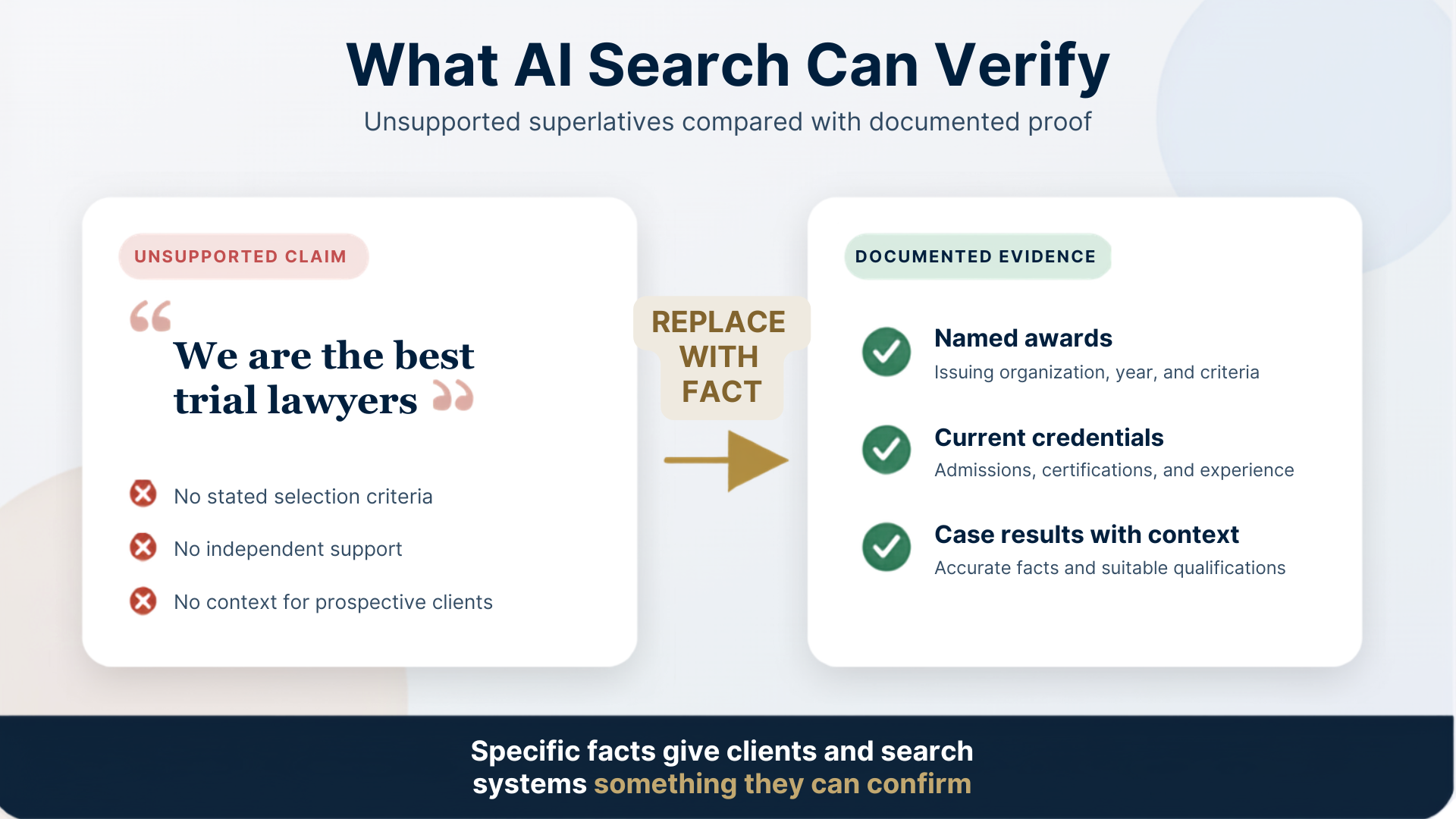
Broad claims provide little support for prospective clients. Specific credentials and properly qualified results give readers facts they can evaluate.
Replace Superlatives With Details Clients Can Check
A practice area page should explain what the firm actually does. Useful details may include the jurisdictions served, matters accepted, attorney experience, litigation background, intake process, and types of clients represented.
Attorney biographies can identify bar admissions, leadership roles, publications, speaking work, representative matters, and valid professional credentials. Each statement should be current and capable of confirmation.
Case results require additional care. A result should include enough factual context to avoid suggesting that another client will receive the same outcome. Awards should identify the issuing organization, year, category, and selection method. Any payment connected with a listing or recognition should be addressed in a manner that prevents readers from mistaking paid placement for an independent honor.
Claims about specialization also require close review. ABA Model Rule 7.2 permits a lawyer to state that the lawyer is certified as a specialist only when the certification comes from an approved or accredited organization and the communication clearly names that organization. State rules may impose further requirements.
Consider the difference between two statements.
“We are the best trial lawyers in Dallas.”
Compared to:
“Our Dallas trial attorneys represent plaintiffs in commercial disputes and serious injury matters in Texas courts. Each attorney biography identifies admissions, representative matters, and professional credentials. Past results include factual context because every matter depends on its own facts and applicable law.”
The first statement asks readers to accept an unsupported conclusion. The second gives them information they can review. The final wording must reflect the firm’s experience and comply with the rules in every applicable jurisdiction.
Keep Outside Profiles and Website Data Accurate
Directory profiles, news coverage, bar association biographies, community roles, and client reviews can give prospective clients information beyond the firm’s own description. Their value comes from the details they provide. A badge or ranking without an explanation leaves many of the same questions as an unsupported superlative.
Firms should review outside profiles for inaccurate practice descriptions, outdated office information, former attorneys, expired awards, and inconsistent firm names. The purpose of this work is accuracy. Google does not promise AI inclusion based on the number of directories, reviews, or media mentions associated with a firm.
Organization structured data can help Google understand and distinguish a business. Google permits organizations to identify details such as their legal name, address, phone number, website, logo, and profiles on other sites. The markup should describe information that also appears on the page.
Valid structured data does not guarantee a particular search appearance. Google may decline to display a search feature even when the markup follows its requirements.
What About the “Best Lawyers” Directory?
In this AI era of search, SEO has moved on from repeating keywords like “best attorney” and evolved to building entity authority through verification. A clean, accurate Best Lawyers profile remains a positive strategy because it acts as an authoritative, third-party validator that satisfies both Google’s AI content guidelines and strict legal advertising rules.
The directory has been a huge trust-building factor for law firms for over 40 years now. In short, AI models use these kind of directories to connect the dots between entities, including the law firm, its attorneys, the office locations, and outstanding awards & recognitions. Seeing a consistent, accurate profile on a highly authoritative external directory like Best Lawyers validates the firm’s identity, making the AI more confident in recommending the firm for relevant user queries.
Run a Claims Audit Before Publication
A claims audit should cover more than the main website copy. Review page titles, headings, metadata, paid ads, local profiles, directory listings, attorney biographies, award pages, and testimonial pages.
For each comparative statement, record the support available for the claim. A phrase such as “leading trial firm” needs a defined basis just as “best trial firm” does. Replacing one broad adjective with another does not resolve the underlying issue.
Every award entry should identify the publisher, date, category, selection process, and any payment associated with inclusion.
Each credential should name the issuing body and remain current. Case results should be accurate and accompanied by suitable context or qualifying language where required.
Structured data should match the information readers can see. Adding unsupported awards, reviews, credentials, or business details to markup creates another source of inconsistency rather than improving the page.
How TSEG Helps Law Firms Replace Labels With Evidence
At TSEG, we help law firms identify unsupported claims across websites, ads, directory profiles, and structured data. We replace broad superlatives with accurate descriptions of attorney experience, practice focus, credentials, and representative work.
We also review how those facts appear across traditional results and AI search features. Our team identifies inconsistencies, assesses the pages cited for valuable searches, and develops content around the questions prospective clients ask before contacting a firm.
Our work connects legal advertising review with search strategy. We help firms present their qualifications clearly, monitor how their content appears, and support client decisions with documented facts rather than labels the firm may be unable to substantiate. For more help with your law firm’s content, reach out to our marketing specialists today.


