Google Rolls Out Agent-Driven Search That Reduces Law Firm Website Traffic
Posted on Friday, April 17th, 2026 at 10:30 am

Search Now Handles the Work Behind the Query
Google is moving beyond lists of links and into task completion. In an interview with Stripe, Sundar Pichai described search as “agentic,” referring to systems that complete requests within a single interaction instead of sending users across multiple websites.
One recent example involves restaurant reservations. A user can describe a preferred time, group size, and setting, and Google assembles options that are ready to book. The process that once required comparing multiple sites now happens in one place.
That change affects how potential clients find legal services. Traditional SEO assumed a sequence where a user searches, reviews results, and visits several websites. That sequence is getting shorter, and in some cases, it disappears altogether.
AI systems now gather information, evaluate options, and present conclusions. For law firms, the key question becomes whether their information is selected and presented during that process.
How AI Is Replacing the Traditional Search Path
Recent updates show how quickly user behavior is changing. Instead of typing keyword-based queries, users can describe a situation in plain language and let the system determine the next steps.
In the restaurant example shared on X by Rose Yao, a single request produces a set of bookable options after scanning multiple platforms. The system handles comparison, filtering, and selection without requiring the user to visit separate sites.
That same pattern applies to legal services. A person dealing with a personal injury matter may describe their situation, location, and urgency. The system can then identify relevant firms and present a shortlist.
This introduces a filtering layer that sits between the user and your website. Instead of competing only for rankings, law firms are competing for inclusion in a curated set of results generated before a click ever happens.
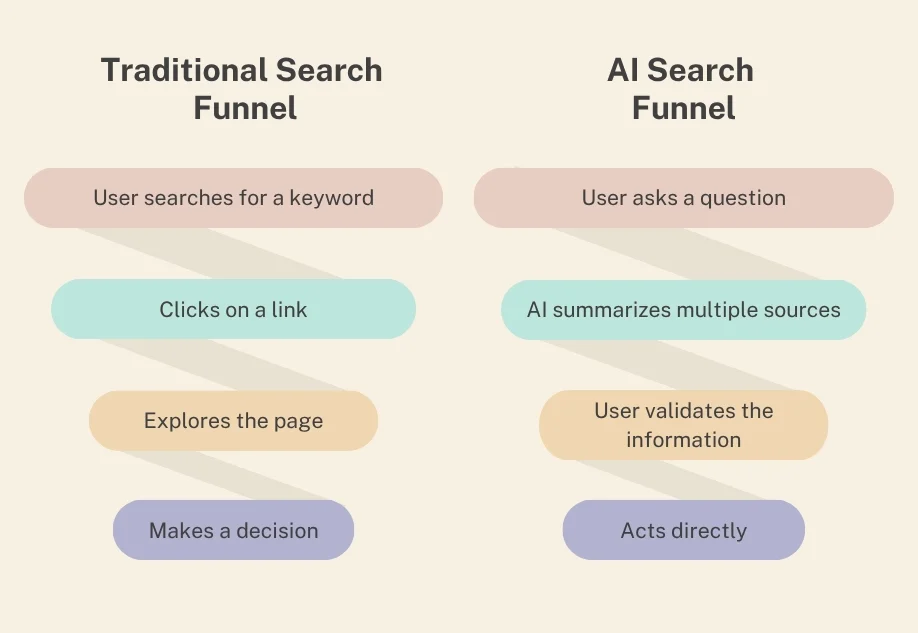
Image by Percumedia shows the difference between traditional search behavior and AI-driven decision making.
Visibility Now Depends on Interpretation, Not Just Ranking
A strong position in search results still matters, but it is no longer the only path to discovery. AI tools review and summarize information before presenting options to users.
For law firms, this creates a new form of evaluation. Systems assess credibility, relevance, and clarity across websites, directories, and third-party platforms. If your firm’s information is inconsistent or unclear, it becomes harder for these systems to determine when to include you.
Practice area pages need to be specific and easy to understand. Location details must match across every platform. Reviews, case results, and third-party mentions contribute to how your firm is perceived.
Competition is also becoming tighter. Instead of appearing in a list of ten results, firms are competing for placement in a much smaller set of recommendations. That smaller pool raises the stakes for accuracy and consistency across every digital touchpoint.
Personalized Search Means No Two Users See the Same Results
AI-driven search introduces a one-to-one experience. Each user receives recommendations shaped by their situation, location, and prior interactions.
Companies like Cloudflare have described AI agents as independent systems that operate more like personal assistants than traditional software. These systems adapt in real time, which means different users can receive entirely different recommendations for the same type of legal issue.
For law firms, this removes the idea of a single, shared results page. Visibility now varies from one user to another. Factors such as urgency, case type, and proximity influence which firms are presented.
This makes consistency across platforms more important. AI systems rely on clear and verifiable information when determining which firms to include. Gaps or conflicting details can reduce the likelihood of being selected.
Building a Digital Presence That AI Systems Can Use
Law firms that want to remain competitive need to focus on how their information is structured and presented.
Start with clarity. Each practice area should have its own page with direct language that explains what the firm handles. Avoid vague descriptions that require interpretation.
Next, ensure that business information is consistent across directories, profiles, and your website. Even small discrepancies can create uncertainty when systems compare data from multiple sources.
Content structure also matters. Clear headings, direct answers to common questions, and organized service pages make it easier for systems to interpret your site. When information is easy to process, it is more likely to be included in recommendations.
Credibility plays a large role as well. Reviews, case results, and mentions on reputable platforms help establish trust. Firms with strong, consistent validation across multiple sources are more likely to be selected.
Technology choices should support these efforts. Platforms that allow for structured content and regular updates make it easier to maintain accuracy as your firm grows.
Why Law Firms That Adapt Early Will Capture More High-Value Cases
Search is moving toward systems that complete tasks and present decisions. Law firms that align their digital presence with how these systems operate will have a clear advantage.
The factors that influence whether your firm is selected by AI still come back to the fundamentals. Clear practice area pages, consistent business information, and credible third-party validation continue to shape how your firm is interpreted and included. These same elements have long supported strong search performance, and they remain closely tied to how AI systems determine which firms are worth surfacing.
We build websites and search strategies designed for how Google operates today. Our team focus on clarity, structure, and consistency so your firm can be accurately interpreted and selected by AI-driven systems. If your goal is to attract better cases while competitors struggle to appear, reach out today and we can help position your firm where these decisions are being made.


