Google’s August 2026 Spam Update Puts Law Firm SEO Practices Under Greater Scrutiny
Posted on Wednesday, September 2nd, 2026 at 6:33 pm

What the August Spam Update Means for Law Firms
Google’s August 2026 spam update gives law firms another reason to review how their websites earn and maintain search rankings. Spam updates are designed to improve Google’s ability to identify practices that violate its spam policies and reduce the search presence of pages that benefit from those methods.
For attorneys, the practical concern is whether a website has accumulated SEO practices that could make its rankings more vulnerable. Content created primarily to capture search traffic, excessive keyword use, repetitive pages, and other tactics designed around gaming search engines rather than the prospective clients you’re trying to help deserve closer examination.
A law firm that experiences ranking drops during or after the rollout should avoid assuming that every change is tied to a single page or SEO tactic. Ranking fluctuations can have multiple causes. Firms should examine which pages and search terms declined, when those declines began, and whether affected areas of the site share common characteristics.
From this update alone, we’re seeing both positive and negative changes in search rankings across multiple practice areas and markets. Thought the severity is not high, it is still worthwhile to check your firm’s rankings and search traffic for any sudden changes to learn how well, or how poorly, your current SEO is performing.
Review Your Law Firm’s Content Closely (Again)
Law firm websites contain hundreds (sometimes thousands) of pages covering practice areas, locations, legal questions, case types, and related topics. That amount of content creates several opportunities to reach prospective clients. Still, it can also create problems when pages become overly repetitive or offer little useful information beyond what already exists elsewhere on the site, or your competitors’. This is something your law firm, or marketing team, should be reviewing regularly as it remains the north star of good content that Google and its AI generated responses trust. Generating content is easy and automatic – reviewing it is manual work that should not be skipped.
Attorneys should implement review processes that check whether their content has a clear purpose and value for the person performing the search. A useful practice area page should explain the legal issue in detail, address questions prospective clients are likely to have, and demonstrate the firm’s local expertise in the matter.
Location pages warrant similar attention. Publishing numerous pages that use nearly identical copy with city names swapped out can create a poor experience and leave little reason for Google to favor one page over competing resources. Each page should provide enough original value to justify its existence.
Keyword use also requires restraint. Repeating practice areas, cities, and attorney terms simply to increase their frequency can make content awkward for readers without improving the page. Search terms should fit naturally within useful information rather than dictate the writing. Nothing screams AI generated slop content more than repetition of keywords or the same phrases over and over again, which is exactly the spammy practices Google is looking for.
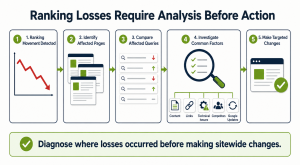
Analyze Ranking Losses, Don’t Overcorrect
A sudden drop in a Google search that you used to dominate can create pressure to rewrite pages, remove content, or make sitewide SEO changes immediately. That response can make it harder to determine what actually caused the movement, and can harm your site in the long-term.
Law firms should begin by identifying where losses occurred. Comparing changes across practice area pages, informational articles, location pages, and other sections can help reveal whether a decline is concentrated or widespread. Search query performance can provide additional context about which areas of the firm’s organic traffic were affected.
The timing matters as well. Ranking movement that coincides with a Google update deserves investigation, but timing alone does not prove that the update caused the decline. Technical problems, competitor improvements, changes to search results, and previous website modifications may also affect performance.
Once the affected pages and queries are identified, firms can focus improvements where they are most likely to matter rather than making broad changes without supporting data.
How TSEG Helps Law Firms Respond to Google Updates
At TSEG, we monitor Google updates and search performance continuously because ranking changes can directly affect the flow of prospective clients to a law firm. Our work does not end when a website reaches strong positions in search results. We stay on top of changes that could affect those positions and evaluate what they mean for each partner law firm.
As rankings move, we analyze the data to determine where movement occurred and what may be contributing to it. That allows us to respond based on the performance of the individual website rather than making unnecessary changes based on broad assumptions about an update.
Our goal is to keep our partner law firm websites ranking highly while adapting their SEO strategies as Google changes how it evaluates websites and search results. When a site experiences negative movement, we work to identify the affected areas, address problems that may be holding pages back, and pursue recovery.
Google updates will continue to affect search results across all industries. We monitor those developments in a legal scope, assess their impact, and act when needed so our law firm partners can protect the search rankings they have earned and work toward bouncing back when rankings decline. If your law firm has suffered from a recent Google update, reach out to our team of experts to start building a path to a dominant local search presence.


