How Law Firms Can Make AI Content Sound More Human
Posted on Thursday, May 14th, 2026 at 5:53 pm
Legal AI Content Still Sounds Artificial to Potential Clients
Law firms have spent the past two years testing generative AI tools like ChatGPT as pressure to publish more website content continues to increase. While many AI-generated articles appear polished at first glance, they often still feel detached and impersonal to readers.
In our 2024 article, we discussed the importance of strategy, empathy, judgment, and creativity when using AI in legal marketing campaigns. Those ideas still matter because readers can often tell when legal content lacks originality or careful editing. Potential clients often search for legal help during stressful situations that require empathy and careful communication.
Problems usually appear when firms rely too heavily on AI-generated drafts without enough editorial review. Many articles repeat the same ideas, rely on predictable sentence patterns, or sound overly formal, which can feel detached from real conversations. The firms getting better results from AI are usually the ones spending more time editing and restructuring drafts. As AI-written material becomes more common across legal marketing, firms using stronger editing standards will usually produce articles that feel more original and less repetitive.
Better Prompts Lead to Better Legal Marketing Content
One of the biggest reasons AI-generated legal content sounds generic is that the prompts behind it are too broad. When someone enters a simple request like “write a blog about personal injury claims,” the AI fills in the gaps on its own. The result is usually surface-level content with repetitive language, vague advice, and little personality. Many firms unknowingly publish articles that sound almost identical to thousands of other AI-generated pages already online.
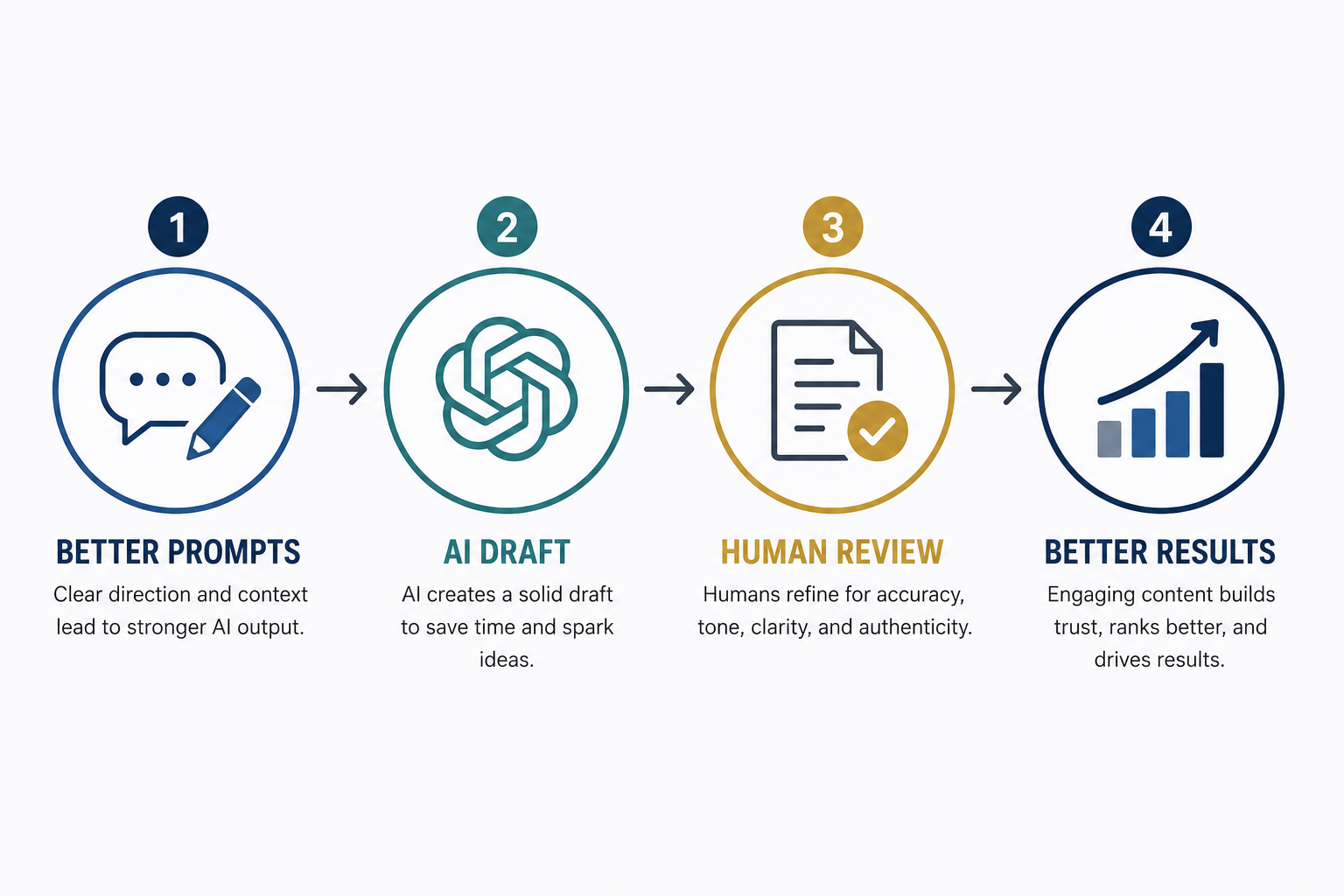
More detailed prompts usually produce drafts with better structure and fewer repetitive patterns. Instead of asking for a general blog post, firms should define the audience, tone, structure, practice area focus, and purpose of the article before drafting begins. Specific tone instructions often help reduce repetitive or overly formal writing.
People researching legal issues usually prefer articles that explain legal topics directly without relying on overly technical language.
Human Review Continues To Matter
Even with stronger prompts, AI-generated legal content still needs human review before publication. Many AI drafts still require substantial editing to remove repetitive wording and improve clarity.
Human editors improve readability by tightening awkward transitions and improving sentence flow. They can also identify wording that feels disconnected from real client concerns. Human oversight also helps prevent exaggerated claims or misleading language that could create ethical concerns in legal advertising.
The editing stage often determines whether an article reads smoothly or feels rushed and formulaic.
The Difference Between SEO Oriented Content and Content People Actually Read
Our 2024 discussion around creativity in AI-assisted legal marketing becomes even more important when looking at how law firms write for search engines today. Many AI-generated articles are technically optimized for rankings, but they still fail to hold a reader’s attention once someone lands on the page. The structure may look organized, yet the content often feels repetitive, overly formal, or emotionally flat.
People searching for legal help are usually dealing with stressful situations and difficult decisions. They want information that feels clear, conversational, and grounded in real concerns. Articles that include relatable examples, natural transitions, and straightforward explanations tend to perform better because readers stay engaged longer. Strong legal content should explain topics clearly without becoming overly rigid or repetitive.
Outlines and summaries generated by AI usually need substantial refinement before publication. Readable content with clear explanations tends to perform better than articles that feel formulaic or written only for search engines.
AI Works Best When Law Firms Treat It Like a Collaborative Tool
Legal firms are seeing better results from AI when editors remain involved throughout the publishing process. Strategy, judgment, empathy, and creativity still guide the process, but now firms are becoming more intentional about how AI fits into their overall marketing workflow. Instead of expecting AI to replace human input, successful firms are using it to support brainstorming, outlining, drafting, and research while keeping people involved throughout the editing process.
Many firms now use AI during early drafting stages while keeping editors involved before publication. That oversight helps firms avoid the generic writing patterns that make so much AI-generated content feel interchangeable.
Readers are becoming better at recognizing repetitive AI-generated writing patterns. The most successful firms are the ones using AI carefully enough that readers never stop to question whether a machine helped write the article in the first place.
The Firms That Win With AI Will Still Sound Human
As AI becomes more common across legal marketing, the firms that stand apart will not be the ones relying on automation alone. The firms producing stronger content will usually be the ones spending more time reviewing and revising drafts before publication. AI can speed up drafting, though the final article still needs a clear voice and careful editing before publication.
That idea connects directly back to the themes we covered in our 2024 article. Strategy, empathy, judgment, and creativity remain the foundation of effective AI-assisted legal marketing because those qualities cannot be fully replicated by software alone. Firms that treat AI as a collaborative tool instead of a complete replacement for human input are in a much stronger position to create content that people actually want to read.
At TSEG, we help law firms combine advanced AI tools with experienced legal marketing strategy to create content that performs well without losing authenticity. From blog development to SEO strategy and editorial refinement, our team helps firms produce marketing that feels polished without losing personality.


