Google Avoids Another Breakup as Federal Judge Rejects Forced Sale of AdX
Posted on Wednesday, September 9th, 2026 at 11:12 pm
Two Years of Google Antitrust Cases Have Produced a Clearer Picture
When we examined Google’s antitrust problems in October 2024, the company had recently lost a major federal case over its dominance in online search. At the time, some of the biggest questions concerned what remedies the court might impose and whether those remedies could alter how people access search engines.
Two years later, Google has avoided some of the most aggressive remedies sought by federal antitrust officials.
The latest development came on September 2, 2026, when U.S. District Judge Leonie Brinkema rejected the Department of Justice’s request to force Google to sell its AdX advertising exchange. The decision came in a separate antitrust case concerning Google’s advertising technology business.
The search and ad tech cases address different parts of Google’s business, but their outcomes provide useful context for law firms that spend heavily on search marketing. Courts have found unlawful monopoly conduct in both matters while declining to dismantle major parts of Google’s business.
That distinction matters when considering what attorneys should expect next from Google Search and digital advertising.
What Happened in Google’s Ad Tech Case
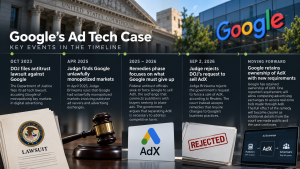
The Department of Justice filed its ad tech lawsuit against Google in 2023. In April 2025, Judge Brinkema found that Google had unlawfully monopolized markets involving publisher ad servers and advertising exchanges.
The remedies phase raised a bigger question: what Google would be required to give up.
Federal antitrust officials sought to sell AdX, the exchange that connects publishers offering advertising space with buyers seeking to place ads. The government argued that separating AdX from Google was necessary to address the competitive harm established in the case.
Judge Brinkema rejected that request on September 2.
According to Reuters, the court instead accepted remedies that require changes to Google’s business practices. One reported requirement will allow competing advertising exchanges to access real-time bids made through AdX.
The full effect of the remedy will become clearer as additional details from the court are made public and the case continues.
For now, Google has retained ownership of AdX.
Google Also Avoided a Chrome Sale in the Search Case
The outcome follows another major victory for Google during the remedies phase of its search antitrust case.
In August 2024, U.S. District Judge Amit Mehta found that Google had maintained an illegal monopoly in general search services and general search text advertising. That ruling was the focus of our previous article about the possible future of SEO.
The Department of Justice later pursued remedies that included forcing Google to sell Chrome.
The court declined to order that sale.
Instead, the remedies imposed restrictions on certain agreements involving the distribution of Google Search, Chrome, Google Assistant, and Gemini. Google was also ordered to provide certain search data to qualifying competitors and offer certain search and search advertising syndication services.
The final judgment was entered in December 2025.
Taken together, the search and ad tech cases show that findings against Google do not automatically lead to the breakup of its products or advertising systems.
What the AdX Decision Means for Law Firm Marketing
Most law firms will not interact directly with the publisher advertising systems at the center of the AdX case. The ruling is still relevant because it adds another chapter to the broader federal effort to reduce Google’s control over digital advertising and search.
For firms using Google Ads, the September ruling does not provide a reason to abandon the platform or make immediate budget changes. Google retained AdX, and the decision does not dismantle Google’s advertising business.
Marketing decisions should continue to depend on performance.
Law firms can compare cost per lead, cost per signed case, lead quality, conversion rates, and case value across their campaigns. If another advertising platform produces stronger results for a particular practice area or market, the data can support moving more money there. An antitrust ruling by itself does not provide that evidence.
The same principle applies to SEO.
Firms should monitor how search competitors develop as the remedies from Google’s search case take effect. At the same time, Google remains a major source of search traffic. SEO plans should respond to how prospective clients actually search rather than assumptions about how an antitrust case might eventually change the market.
The Next Decisions Still Matter
Google’s antitrust litigation is far from irrelevant simply because courts rejected two proposed divestitures.
The remedies imposed in the search case can affect how competitors access search data and distribute their products. Requirements in the ad tech case can affect how competing advertising exchanges interact with Google’s systems. The Department of Justice also said after the September 2 ruling that it was evaluating its next steps.
Law firms should therefore follow what Google is required to do rather than focusing exclusively on whether the company is ordered to sell a major product.
That approach gives marketing teams a more practical way to evaluate future developments. Changes to search distribution, advertising access, competition, pricing, or user behavior can eventually affect where firms invest their marketing dollars. Those effects should be measured as they occur.
TSEG Will Keep Law Firms Focused on What Affects Cases
Google has now spent several years defending major federal antitrust cases while continuing to play a central role in how consumers find businesses and how advertisers reach them.
For law firms, the question is how each court-ordered change affects the ability to generate qualified leads and signed cases.
At TSEG, we follow developments involving Google Search, paid advertising, and search marketing so our clients can make decisions based on what is happening in the market. We can help law firms evaluate SEO and paid search performance, compare marketing channels, and respond when changes at Google begin affecting client acquisition.
As the remedies from Google’s antitrust cases take effect, we will continue measuring what matters for law firms and adjusting our work when the data supports a different approach.


